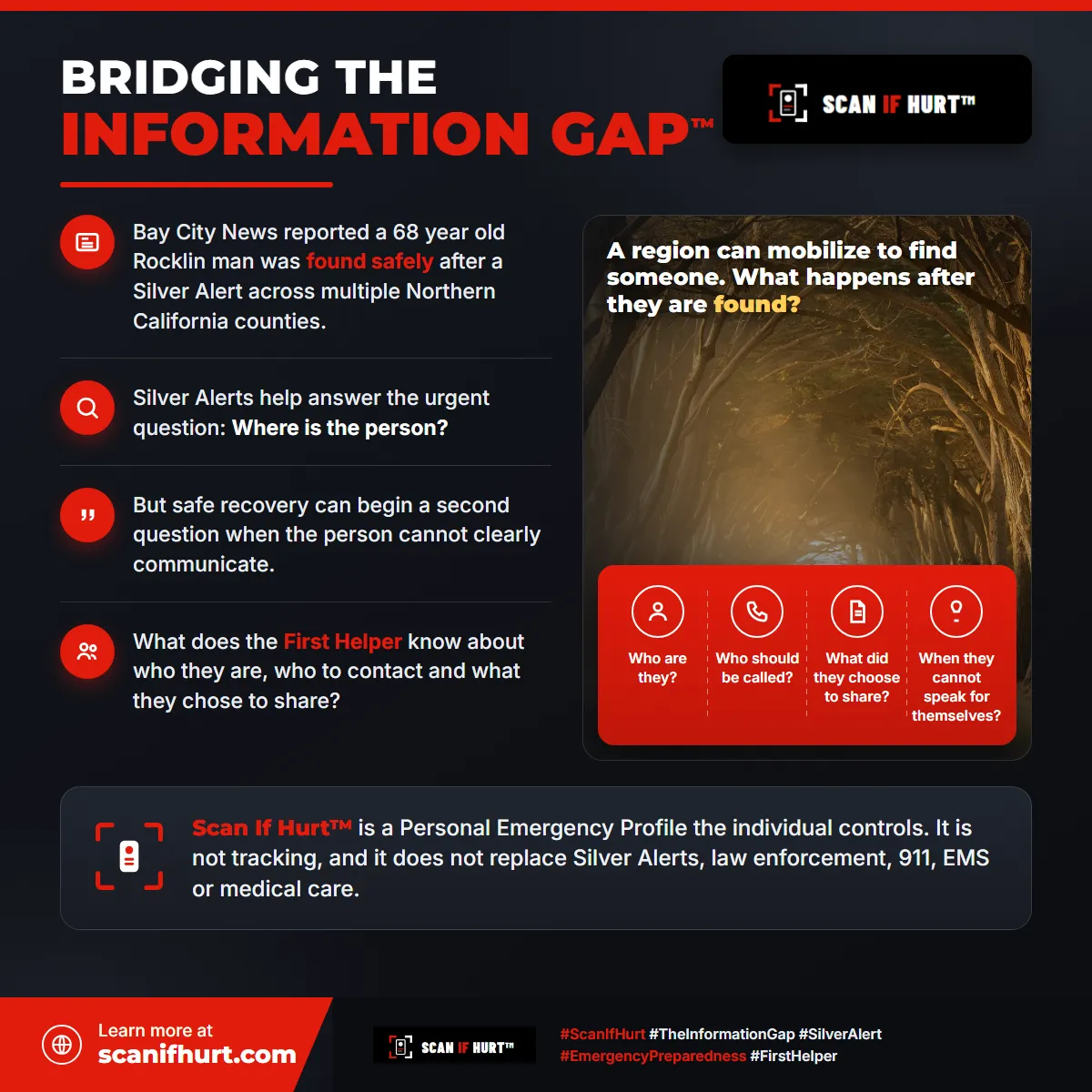
A Silver Alert Can Mobilize a Region. What Happens After Someone Is Found?
When an at-risk person goes missing, a community can become part of the response very quickly.
Law enforcement issues an alert. Newsrooms spread it. People watch roads, stores and neighborhoods. Information crosses city and county lines because the immediate objective is simple: locate the person safely.
Bay City News Service reported on August 28 that a Silver Alert for 68-year-old Michael Fitzgibbons was canceled after he was found safely. The alert had extended across multiple Northern California counties.
That is the outcome everyone wants.
It also highlights an important distinction in emergency preparedness: finding someone and helping someone after they are found are not always the same information problem.
Community readiness has more than one phase
Silver Alerts and missing-person systems are designed to help locate someone.
Once the person is found, the situation changes. The first person helping may be a law-enforcement officer, first responder, employee, passerby or another member of the community.
In some cases, a found person may be unable to clearly communicate. That statement is not about what happened in the Rocklin case; the public reporting does not establish what information was available when Fitzgibbons was located, and there is no reason to speculate.
The broader preparedness question is still worth asking:
If a person cannot speak for themselves when help reaches them, what information have they chosen to make accessible?
Repeated stories are a signal
This is not the only recent story involving an at-risk missing person being found safely.
Repeated coverage does not make the issue less useful to discuss. It makes the pattern more visible.
Wandering, Silver Alerts, autism-related missing-person response, dementia-related risk and other vulnerable-person searches all involve systems designed to solve the location problem.
A complete preparedness conversation can also consider the personal-information problem that may follow.
A person-controlled information layer
Scan If Hurt™ gives an individual a Personal Emergency Profile they control. A scannable Safety ID can make information they chose to share accessible when they cannot speak for themselves.
That may include identity, emergency contacts, a Message to EMS or other information the individual decided should be available in an emergency.
Scan If Hurt™ is not a tracking system. It does not replace Silver Alerts, supervision, law enforcement, 911, EMS or medical care.
It addresses a different part of preparedness: The Information Gap™ — the period when the person with the answers may not be able to provide them and someone else is trying to help.
A community can mobilize to find someone.
Preparedness should also consider what happens when the community succeeds.
Sources: Bay City News Service, August 28, 2026; Bay City News August 28 general-news archive.
