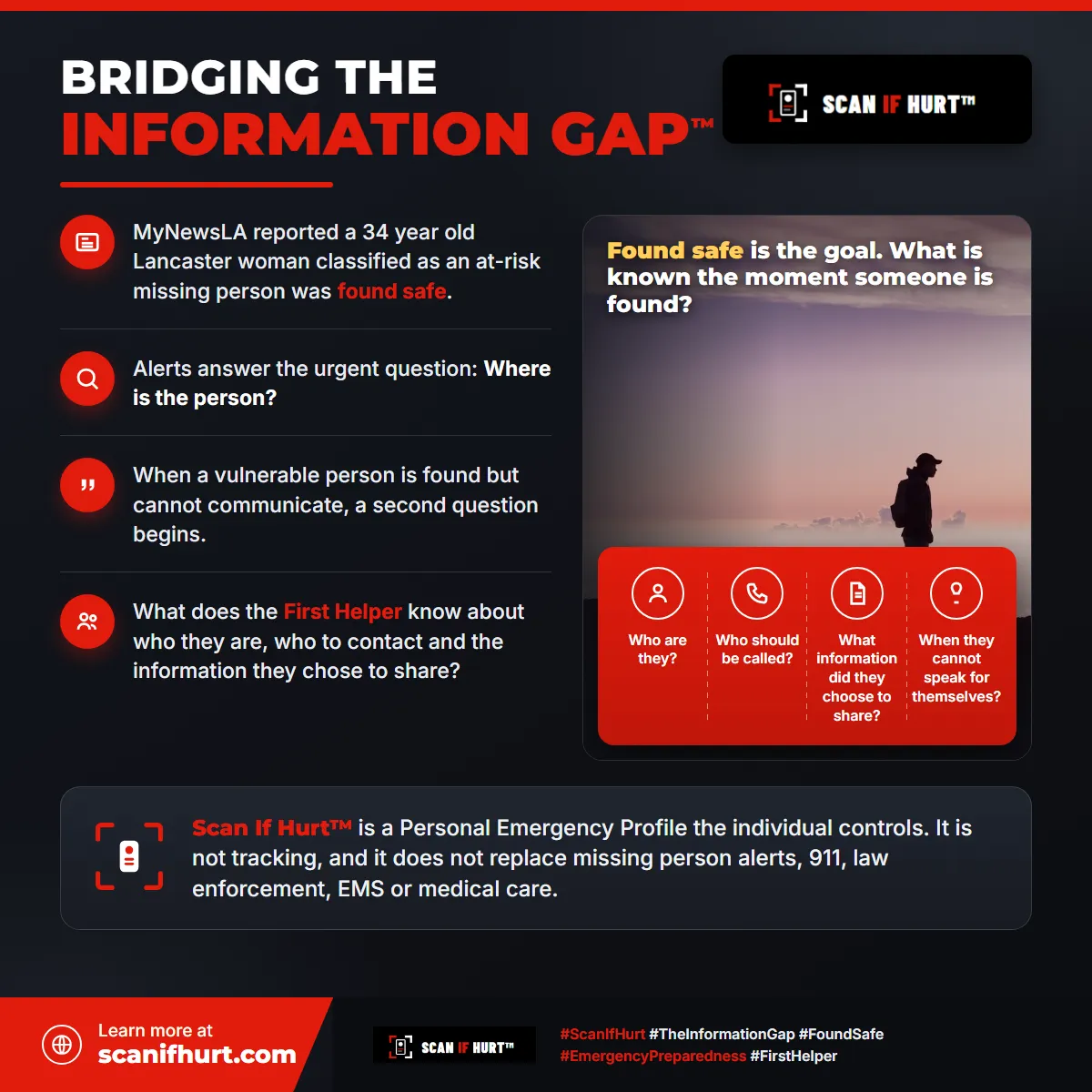
Found Safe Is the Goal. What Information Is Available at the Moment Someone Is Found?
Missing-person alerts are built around urgency.
A person is missing. Authorities need the public to help locate them. Descriptions, last-known locations and alert systems are used to answer the most immediate question: Where is this person?
MyNewsLA reported on August 28 that a 34-year-old Lancaster woman who had been classified as an at-risk missing person was found safe after authorities had asked for the public's help.
That is the outcome everyone wants.
It also illustrates a separate preparedness question that exists beyond the search itself.
Being found can begin a new information need
In some emergencies, the person who is found may be confused, injured, overwhelmed or otherwise unable to reliably explain who they are, who should be contacted or what information they want helpers to know.
That does not mean any of those circumstances applied in the Lancaster case. Authorities did not release details about where or how the woman was found, and there is no reason to speculate.
The broader question is worth preparing for in advance:
If a person cannot speak for themselves when someone finds them, what information is available to the first person trying to help?
Search systems and personal information solve different problems
Missing-person alerts, law enforcement searches and community notifications are designed to help locate someone.
Scan If Hurt™ addresses a different problem: The Information Gap™ — the critical period between the moment a person cannot communicate and the moment the first person on scene has enough information to help.
Scan If Hurt™ gives the individual a Personal Emergency Profile they control. A scannable Safety ID can make information they chose to share available when they cannot speak for themselves.
That may include identity, emergency contacts or other information the individual decided should be accessible in an emergency.
Scan If Hurt™ is not a tracking system. It does not replace supervision, missing-person alerts, 911, law enforcement, EMS or medical care.
Preparedness does not end when the person is located
On August 21, HHS announced a National Autism Missing and Endangered Person Alert Initiative focused on improving coordination among emergency managers, law enforcement, first responders and community partners when autistic children or adults are reported missing.
That work focuses appropriately on faster alerts, searches and safe recovery.
There is room beside those systems for another simple question: What information has the individual chosen to make accessible if they cannot provide it themselves?
Finding someone safely is the goal. Making sure the person does not become unidentified, voiceless, or their loved ones unknown is part of the preparedness conversation too.
Sources: MyNewsLA, August 28, 2026; U.S. Department of Health and Human Services, August 21, 2026.
