Illinois Has New E-Bike Rules. What Happens After a Serious Crash?
Illinois has taken a major step toward standardizing how e-bikes, e-motos and other electric micromobility devices are regulated across the state.
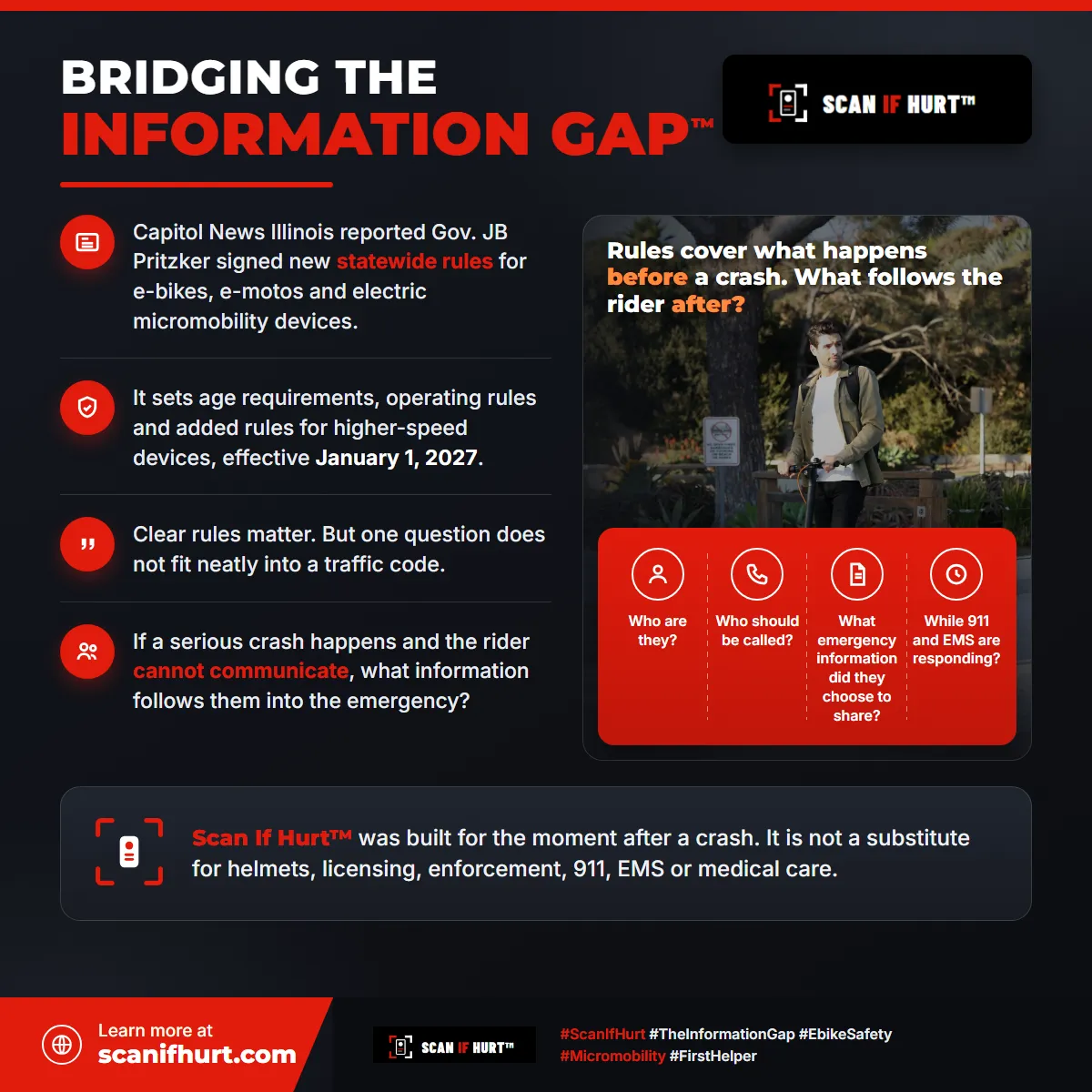
Capitol News Illinois reported that the newly signed law establishes statewide age requirements, operating rules and additional requirements for higher-speed devices. The framework is scheduled to take effect January 1, 2027.
Those rules address an important part of the safety problem: what should happen before a crash.
They define who may operate certain devices, where they may be used and what responsibilities apply to higher-powered machines.
But even a strong prevention and accountability system cannot eliminate every emergency.
A different problem begins after the crash
Imagine a rider is seriously injured and cannot communicate.
The first person who stops may be a stranger, another rider, a parent, a police officer or someone nearby who simply saw what happened.
That person can call 911. But they may still have almost no personal information about the rider.
Who are they? Who should be contacted? Is there emergency information the rider chose to make available?
Those are not traffic-law questions. They are information-readiness questions.
The Information Gap™ is separate from regulation
We use the term The Information Gap™ for the period when someone cannot speak for themselves and the First Helper has little or no useful personal information to work with.
That gap can exist even when everyone followed the rules.
Scan If Hurt™ was built for that narrow post-incident problem. A Safety ID can provide access to a Personal Emergency Profile containing information the person chose to share, such as identity, emergency contacts and a Message to EMS.
It is not a substitute for helmets, licensing, registration, insurance requirements, enforcement, 911, EMS or medical care.
Those systems solve different problems.
A complete safety system has more than one layer
Illinois' new law is an example of states trying to catch up with a rapidly changing category of vehicles.
That work matters.
But as lawmakers, schools, municipalities, families and public-safety organizations build better micromobility systems, there is another question worth including:
If a serious crash happens and the rider cannot answer for themselves, what information will the First Helper have?
Prevention and regulation reduce risk. Post-incident information preparedness addresses what remains when an emergency still happens.
A complete safety conversation should make room for both.
Source: Capitol News Illinois, Ben Szalinski, August 26, 2026.
