E-bike Rules Can Reduce Risk. What Belongs in the Safety Plan After That?
When a school district changes policy after a series of accidents, the first question is usually whether the new rule will reduce risk.
That is exactly the question Newport-Mesa Unified is trying to answer.
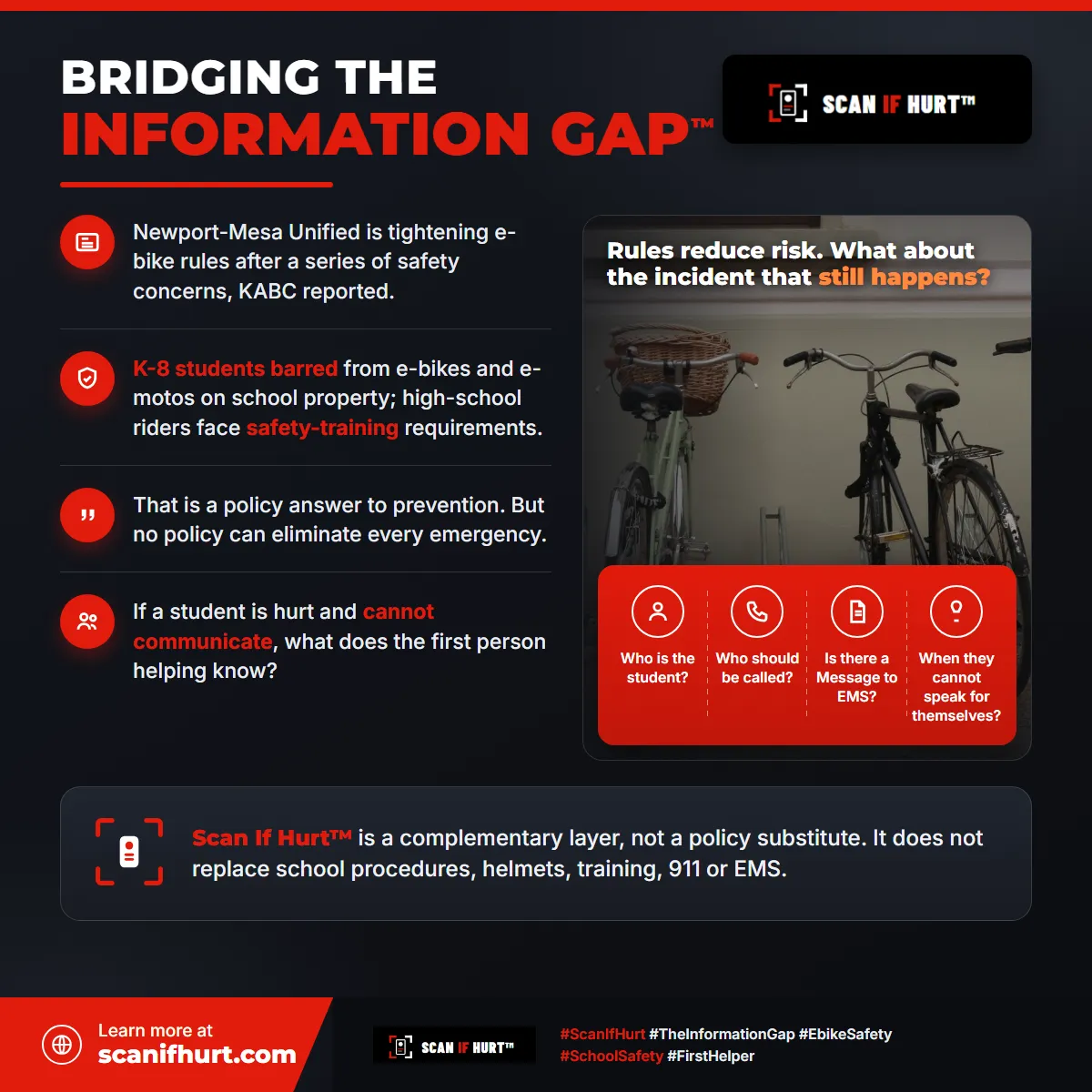
KABC reported that the Orange County district is prohibiting K-8 students from possessing or riding e-bikes and e-motos on school property and requiring safety training for high-school e-bike riders.
Whether another district chooses the same policy is a separate debate. The larger point is that prevention measures have a defined job.
Policies are designed to reduce the chance of an incident
Age restrictions, training requirements, helmet rules and school-property policies all try to influence what happens before a crash.
They may reduce exposure. They may improve behavior. They may give families and schools clearer expectations.
What they cannot do is guarantee that no student will ever be injured.
The safety plan needs an after-the-incident layer too
Suppose an incident occurs despite the rules.
The first person helping may not be a responder. It may be someone from the school community or a stranger nearby.
Calling 911 is the obvious first action. But another set of questions can appear immediately if the student cannot communicate.
Who are they? Who needs to be contacted? What information did the family choose to make available for an emergency?
We call that missing-information period The Information Gap™.
Scan If Hurt is a complementary layer, not a policy substitute
Scan If Hurt™ is not an argument against prevention rules. It does not replace school procedures, helmets, training, 911 or EMS.
Its role is narrower. A scan can provide access to information the person or family chose to share, including identity, emergency contacts and a Message to EMS, when the person cannot speak for themselves.
That is why the most useful safety question may not be, "Which approach is better, rules or preparedness?"
They solve different problems.
One tries to reduce the chance that the emergency happens. The other asks what information is available if it does.
A complete safety plan has room for both.
Source: KABC, August 25, 2026.
