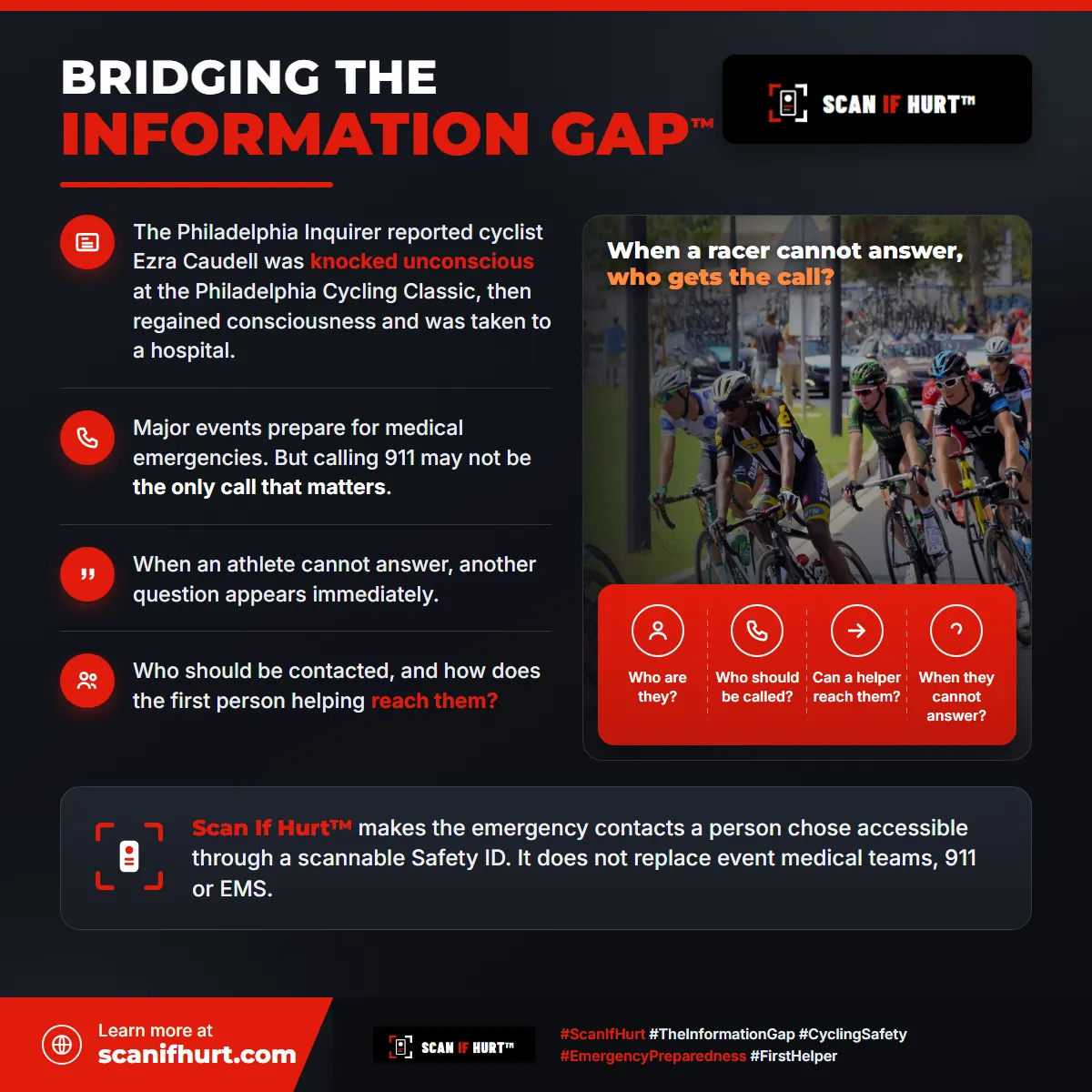
When an Athlete Cannot Answer, Who Gets the Call?
Competitive cycling is built around preparation.
Athletes train. Organizers design courses. Medical teams and emergency services plan for crashes and injuries.
The Philadelphia Inquirer reported during the August 30 Philadelphia Cycling Classic that cyclist Ezra Caudell was knocked unconscious in a crash, later regained consciousness and was transported to a hospital for assessment.
The report does not say whether emergency-contact information was needed or how it was handled. There is no reason to speculate.
The incident still raises a useful question for any sport where an athlete may temporarily be unable to answer:
How is the right person identified and reached?
Emergency response and emergency contact are different jobs
Calling 911 activates professional emergency response.
Reaching a parent, spouse, partner or other chosen emergency contact is a different information task. In many situations, someone nearby already knows the person. In others—races, travel, public events, recreational riding—that assumption may be less reliable.
The medical response can be excellent and still leave a separate human question: who needs to know?
Scan If Hurt™ lets the athlete decide that in advance by making chosen emergency contacts accessible through a scannable Safety ID.
That is the part of The Information Gap™ this story highlights—not how the crash is treated, but how the athlete's chosen people can be identified and reached when the athlete cannot answer.
